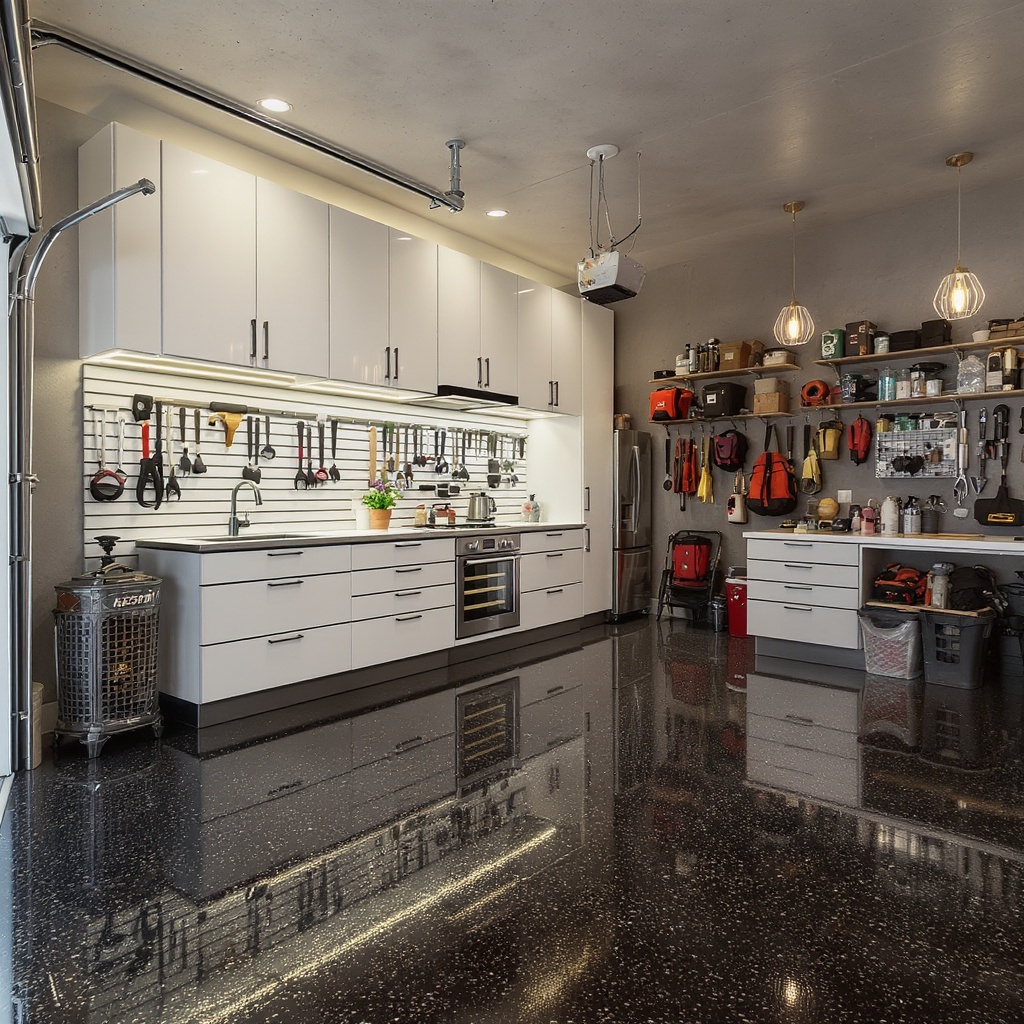
I do a lot of quote calls in garages. Most of them have the same problem: they're not really garages anymore. They're oversized storage units with a car shoved in the corner, or a workout space squeezed between a workbench and a pile of boxes that "we'll deal with eventually."
The epoxy floor is almost always the first thing that gets fixed. It changes the whole feel of the space. But the floor is really the foundation — there's a lot of other work that turns "nice looking garage" into "space I actually use every day."
These are the five upgrades I've seen make the biggest difference for homeowners in the Orlando area. None of them are cheap, but none of them are luxury either — they're practical, and they stack. A garage with all five is a genuinely different space than one with none.
The 5 Upgrades
LED Shop Lighting
The single most impactful upgrade for a garage that costs under $1,000. Replace the builder-grade bare bulb with a grid of LED shop fixtures (4-foot, 5000K daylight temperature). The difference in usable light is enormous — you can actually see what you're working on. For garages used as workshops, home gyms, or hobby spaces, proper lighting is a quality-of-life issue.
Slatwall Wall Organization
Horizontal slat panels mounted on the back and side walls of the garage — the same system used in commercial storage and showrooms. Hooks, baskets, and shelves snap into any position on the slats without drilling. You can reorganize the entire wall in 20 minutes. It keeps tools, sports equipment, and yard gear off the floor and gives the garage a clean, finished look that's easy to maintain.
Overhead Storage Racks
The area above your car — and the ceiling above your work area — is dead space that most garages waste entirely. Ceiling-mounted storage racks rated for 600–1,000 lbs take seasonal items, bins, and bulky gear off the floor and free up wall space for active use. Important: make sure the ceiling is rated for the weight and that the racks are anchored into ceiling joists, not just drywall.
Built-In or Freestanding Cabinetry
A good workbench with integrated storage underneath turns a garage from "corner of chaos" into "functional workspace." You can go modular (Gladiator, Stanley, or similar premium garage systems) or custom-built cabinetry. Either way, cabinet storage keeps chemicals, tools, and materials off the floor and out of the car zone. Lockable cabinets for anything with kids in the house.
Themed Setup: Man Cave, She Shed, or Workshop
Once the floor, lighting, and storage are handled, the use case is whatever you want it to be. A garage gym needs rubber matting, mirrors, and a fan. A man cave or entertainment garage needs climate control (mini-split AC), a speaker system, and some form of heating/cooling. A serious workshop needs dedicated circuits for power tools, a dust collection point, and task lighting at the bench. Define the use and spec the infrastructure to match.
How These Stack Together
The nice thing about these upgrades is that they work together and the order of operations is pretty intuitive:
- First: Get the electrical right — overhead lights, any new outlets, workbench circuits. Do this before the floor goes in so you're not cutting into new polyaspartic.
- Second: Mount the slatwall, cabinets, and any wall storage. Do it before the floor so you're not drilling into a fresh topcoat.
- Third: Install the overhead racks (ceiling-mounted, so no floor impact).
- Last: Epoxy floor goes in last — after all the drilling, cutting, and dust-generating work is done. The floor stays clean and you get the payoff finish at the end.
One mistake I see a lot: people install the epoxy floor, then hire someone to mount cabinets or run electrical. The result is a fresh polyaspartic topcoat covered in drywall dust, wood shavings, and scuff marks from ladders. Schedule the floor last. Let the other trades do their work first, get everything cleaned up, then lay the epoxy into a clean, finished space.
What Actually Adds Home Value
Not all of these upgrades are equal from a real estate perspective. The ones that show in listing photos and appraisal comparisons are:
- Epoxy floor — clean, finished garage floor is a top mentioned item in comparable sales in the Orlando $300k–$600k range
- LED lighting — noticeable, cheap to do, clearly an improvement
- Cabinetry and storage systems — shows as "garage improvements" in comps
The themed setups (man cave, gym) are harder to quantify in value but can be decisive for specific buyer profiles. A family with teenagers who uses the garage as the main hangout space will pay a premium for a finished, climate-controlled garage. The same logic applies to a buyer who works from home and wants a dedicated hobby space — but those buyers self-select.
How We Help
When I do a quote for a garage floor, I always ask what the garage is used for and what it will be used for in the next five years. If you're planning to add a workshop, a gym, or a hangout space, we can talk about how the floor should be spec'd — different uses have different requirements for slip resistance, impact resistance, and maintenance.
If you want the full white-glove garage treatment — floor, lighting, storage, climate control — I can refer you to contractors I've worked with. I'm not trying to upsell you on things I don't install; I just want the floor to look great in a space that's actually being used well.
Tell me how you use your garage — I'll tell you what the floor needs to do for you.
Get Free Estimate → We work around the whole space, not just the floor.