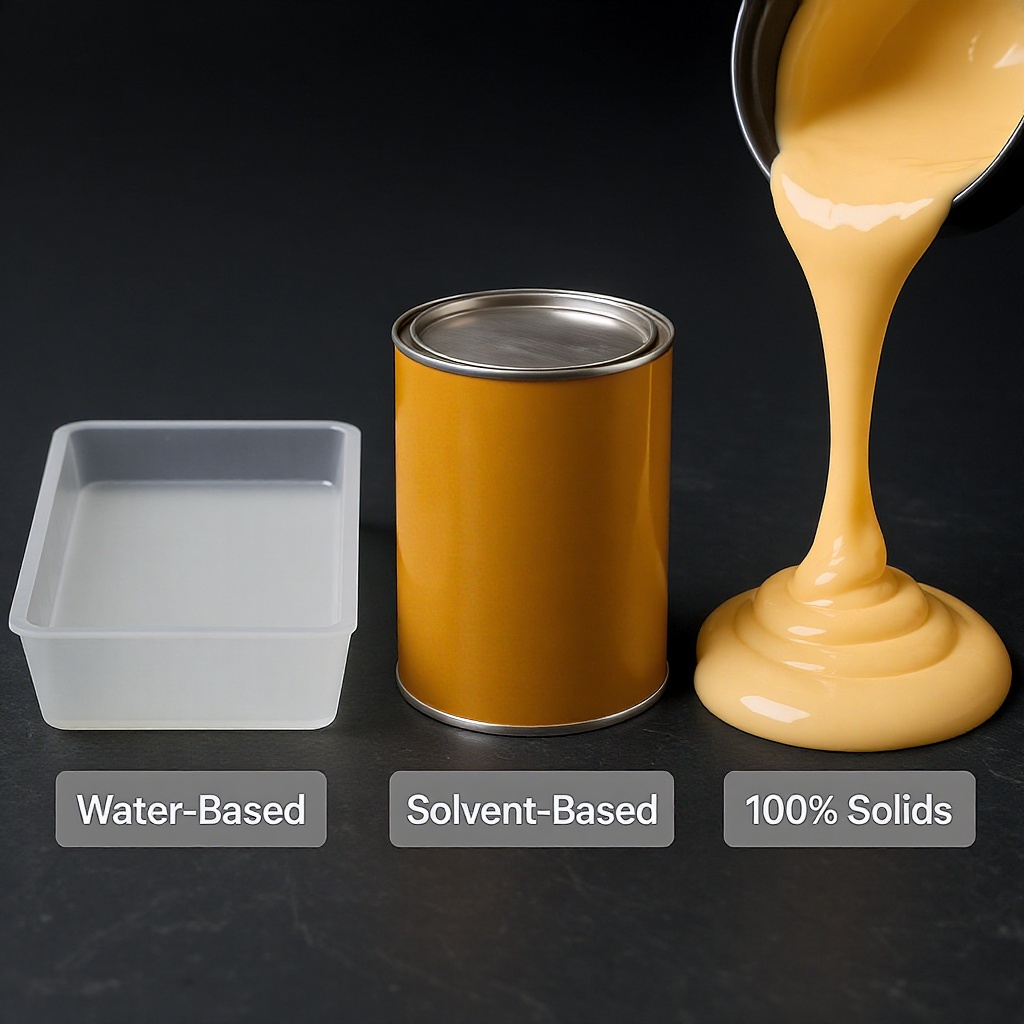
I've had homeowners tell me they got three quotes and all three contractors said they use "industrial-grade epoxy." That phrase is meaningless. It's marketing language that can describe anything from a $40/gallon water-based kit to a $200/gallon 100% solids system.
Here's the actual difference — and why it matters for your garage floor.
The Three Types of Epoxy
Epoxy coatings are categorized by their solids content — the percentage of the material that stays on the floor after the product cures (vs. evaporating off as solvent or water). This distinction is fundamental, and it's where almost all the quality difference lives.
Water-Based Epoxy
30–50% solids. The carrier is water, which evaporates during cure. Very low film thickness. Easy to apply, low odor, but thin and not durable in heavy-use applications. Common in hardware store kits.
Good for: concrete stain, not floorsSolvent-Based Epoxy
50–75% solids. Carried in solvents (xylene, acetone) that evaporate off during cure. Better film thickness than water-based, but high VOCs, strong odor, and the solvents can be problematic in humid conditions.
Used in some commercial applications100% Solids Epoxy
100% solids — no carrier, no solvent, no water. The entire mixed product stays on the floor and cures in place. Maximum film thickness, maximum bond strength, maximum durability. This is what we use.
Our standard. Every job.Why "100% Solids" Means a Better Floor
When you mix a 100% solids epoxy — part A resin + part B hardener — you're putting 100% of that material onto your floor. It cross-links chemically during the cure and forms a dense, solid, fully-bonded film. That film is:
- Thicker — 100% solids applied at 10–16 mils wet gives you 10–16 mils of cured film. A water-based product applied at the same wet thickness might give you 3–5 mils of cured film (the rest is water that evaporated off).
- Stronger — The cross-link density is higher, which means better chemical resistance, better adhesion to concrete, and better impact resistance.
- More stable — No solvents means no off-gassing during and after cure. No shrinkage as carriers evaporate. Consistent film thickness throughout the floor.
The Comparison Table
| Property | Water-Based | Solvent-Based | 100% Solids |
|---|---|---|---|
| Solids content | 30–50% | 50–75% | 100% |
| Film thickness (per coat) | 3–6 mils | 6–12 mils | 10–16 mils |
| Adhesion to concrete | Moderate | Good | Excellent |
| Chemical resistance | Low | Moderate | High |
| UV stability (topcoat) | Varies | Varies | High (with polyaspartic) |
| Typical lifespan | 2–5 years in garage | 5–8 years | 10–15+ years |
| VOC / odor | Low | High | Low (minimal) |
| Price (raw material) | Low | Moderate | Premium |
Why Do Cheap Kits Use Water-Based?
Water-based products are cheaper, easier to apply, and have lower regulatory hurdles (VOCs, flammability). You can sell a $200 kit at the hardware store, put "industrial epoxy" on the label, and a homeowner who doesn't know the difference will buy it thinking they got a professional product.
The problems show up in 12–18 months. Tire marks that won't come out. Areas near the garage door that yellow and chalk. The edges and corners that start to peel. The floor that looked great the day it was done but looks tired two years later.
A water-based epoxy has half the film thickness of 100% solids in the same application. That's not a marketing claim — it's simple math. If you apply it at 10 mils wet, you get 3–5 mils cured. If you apply 100% solids at 10 mils wet, you get 10 mils cured. That difference in cured film thickness is the difference between a floor that lasts and a floor that fails.
When you're getting a quote, ask: "What is the solids content of the base coat you're using?" If they can't answer — or if they say "it's industrial grade" without specifying — that's a red flag. Ask for the product name and the technical data sheet. A contractor who knows their materials can pull up the TDS in 30 seconds. One who doesn't know may be using whatever product was cheapest that month.
What Polyaspartic Does on Top
The base coat (100% solids epoxy) and the topcoat (polyaspartic) are different chemistries with different purposes. Think of it this way: the epoxy base coat is the structural adhesive — it's what bonds everything to the concrete. The polyaspartic topcoat is the armor — it's what takes the abuse from UV, foot traffic, vehicle weight, and chemical spills.
Polyaspartic is an aliphatic polyurea. It's not an epoxy, though it looks similar. Key differences:
- UV stability — aliphatic chemistry doesn't yellow in UV. Epoxy does. This matters in a garage with natural light or a door that stays open.
- Faster cure — polyaspartic can be force-cured in 4–6 hours vs. 24–48 for epoxy. Faster return to service.
- Harder finish — polyaspartic has higher scratch and abrasion resistance than standard epoxy topcoats.
- Temperature tolerance — polyaspartic can be applied in a wider temperature range than epoxy, which matters in unconditioned Florida garages.
The Bottom Line
100% solids epoxy is not a luxury — it's the minimum spec for a floor that's going to last 10+ years in a Central Florida garage. Water-based products have their place (primers, concrete stains, low-traffic surfaces), but for a garage floor you're investing $2,000–$5,000 in, 100% solids is the only answer that makes sense.
When you get a quote from Southern Epoxy, you're getting 100% solids basecoat — every time, on every job. That's not an upsell. It's the product. We don't use anything else because nothing else does the job right.
Questions about the products we use? Ask on the quote call — I'll send you the technical data sheets and walk you through the spec.
Get Free Estimate → No commitment. Full product transparency.